
Inside Hazard Navigator
Three layers, one model — ingest the siloes into a governed structure, explore it at the point of decision, and run the analytics that keep your hazard basis current, consistent, and revalidation-ready.
One unified understanding of your safety system — working for you.
Hazard Navigator builds one governed, structured model of your safety system. That single asset pays off two ways.
A current, complete, consistent hazard basis — revalidations cleared, MOCs reconciled, study quality held to a standard, every value traced to source. The basis you can defend in an audit.
The right safeguard context at the moment of action — what a device protects, what must be isolated before work, and the cost of a bypass. Fewer nuisance trips — and the business case that funds the program.
The siloes, finally in one place
Hazard Navigator pulls together the sources that have always lived apart and maps them onto a common structure — so they can be reasoned about together.
- ~270 equipment types and ~2,800 failure modes, standardized
- 12 discriminating consequence types sourced from 183 distinct hazardous conditions
- A device in an MOC, a scenario in a study, and an event in an incident report finally connect
- Every value grounded to its source with a content hash — auditable from day one
The whole picture, at the point of decision
The Explorers put the unified model at the fingertips of the people making operational calls. Start from any device, scenario, change, or incident and see everything connected to it.
- What a safeguard protects against, and the consequence of bypassing it
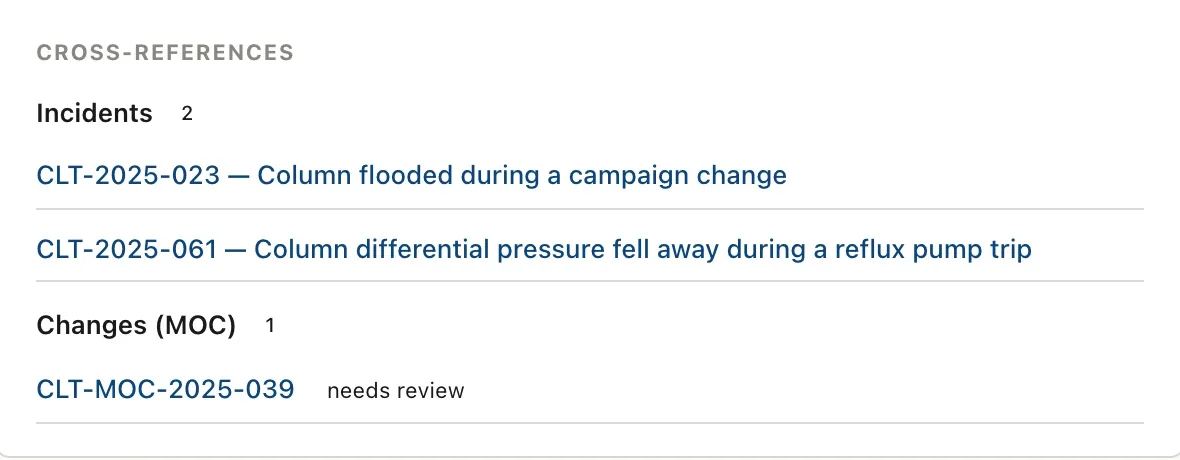
- Every piece of equipment, all MOC records that impact it, and every incident the equipment was involved with
- The complexity of a modern SIS demystified — with the source one click away
Every study complete, comprehensive, and efficient
Compass is the engine of study quality — and it supports the authoring itself, so your specialists spend their judgment on the analysis, not the paperwork.
- Complete — no missing scenarios, causes, or safeguards
- Comprehensive — every credible event, covered consistently against a standard
- Efficient — effort spent where the hazard is, not duplicated
An evergreen PHA — and the actions that reduce risk
A PHA is usually stale before the binder closes. Spyglass keeps it alive, continuously reconciling changes and incidents against the hazard basis — so a revalidation is a refresh, not a restart.
- Detects hazard accumulation, safeguard-crediting contradictions, and MOC→scenario impact
- Runs the millions of cross-checks that surface the non-obvious connection
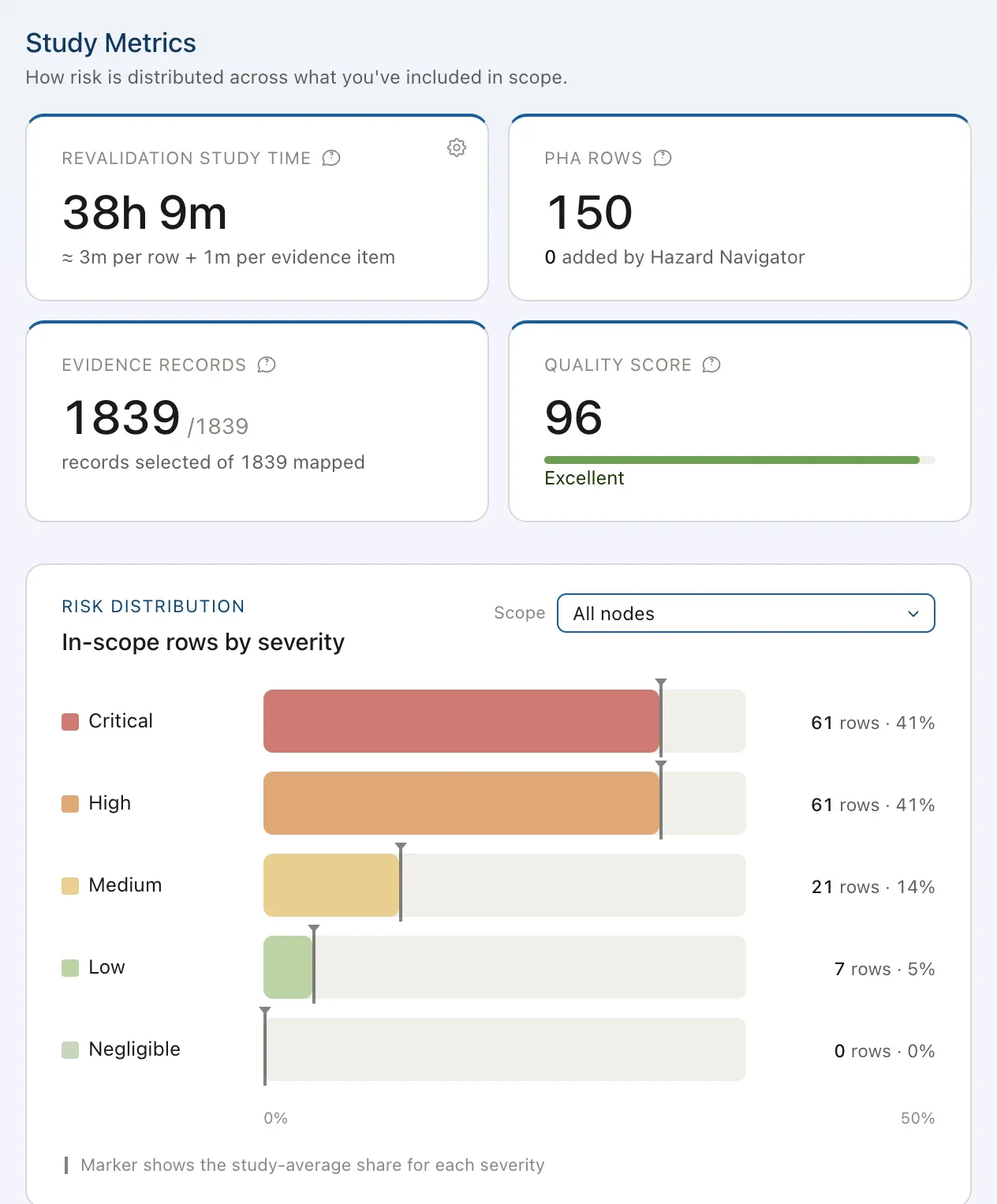
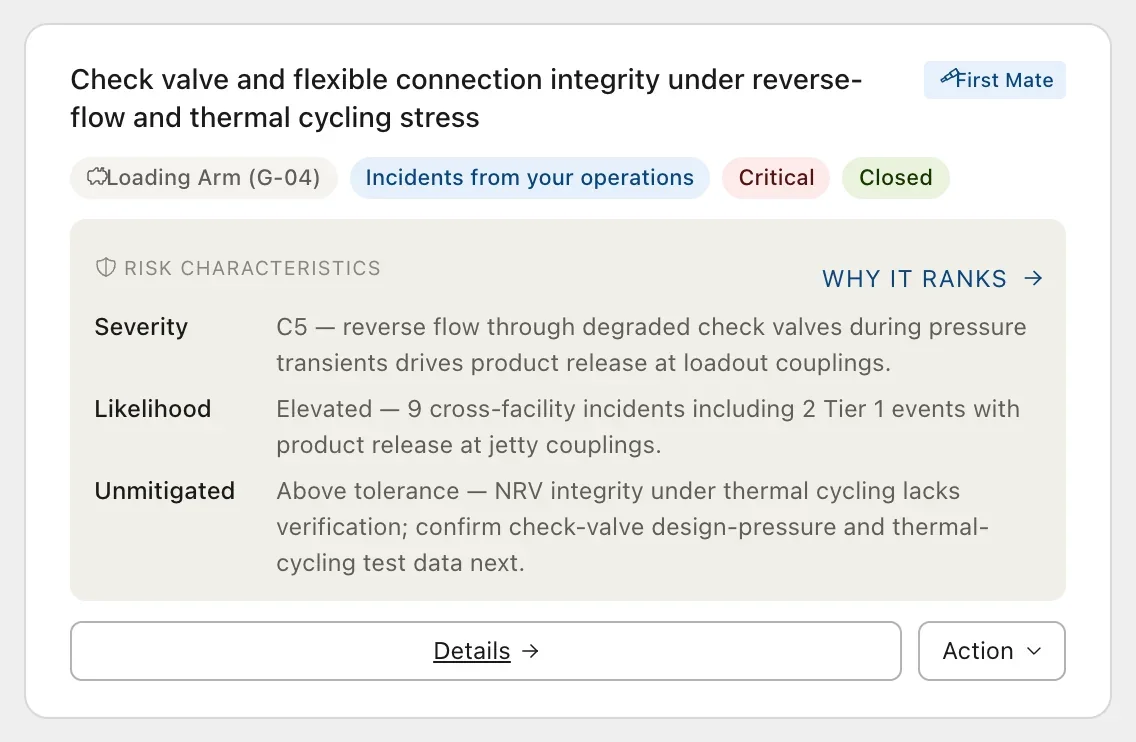
- Ranks your top risk reduction opportunities for upset, incident, and downtime — with the evidence behind each
An engineer who reads every MOC in detail — catching hazard as it accumulates across changes no one looked at together. Who cross-checks every incident, yours and the industry’s, against your own design. Who studies every device and safeguard for the hazard the risk study missed, and ranks what’s most likely to bite you next.
You’d hire them without blinking.
On one representative facility — from real customer data — that is roughly 13.4 million cross-checks, on the order of a hundred person-years. And the connection that takes a plant down is, by its very nature, the one no single person was ever holding.
Not work you’re behind on. Risk you’re carrying blind.
one connection in 13.4M on a real facility — the one no single person was holding
Both payoffs, from one structured model
Pairwise relevance judgments on one real dataset
~110 person-years of expert effort, run deterministically.
Equipment types and failure modes
With detection of safeguard-crediting contradictions and MOC→scenario impact.
Given a device, instantly
What it protects against, the consequence of bypassing it, and compensating measures.
Carries a grounding status
An evidence pointer with a content hash to source — the line an ungoverned model cannot cross.
Concrete findings, not another dashboard to babysit
Point Hazard Navigator at your studies, changes, permits, and incidents. It returns specific, ranked, source-grounded findings — the kind your best engineer would surface if she had a hundred years to read.
- MOCs with unresolved hazard-basis impact
- Safeguards credited inconsistently across studies and operating modes
- Missing or stale PHA scenarios, and incident patterns that match your equipment
- Bypass and isolation context at the permit — and ranked risk reduction opportunities, each linked to source
Select to open full size.
Real output, from the actual product
Not mockups. These are screens from Hazard Navigator — every finding ranked, explained, and traceable to the document behind it.
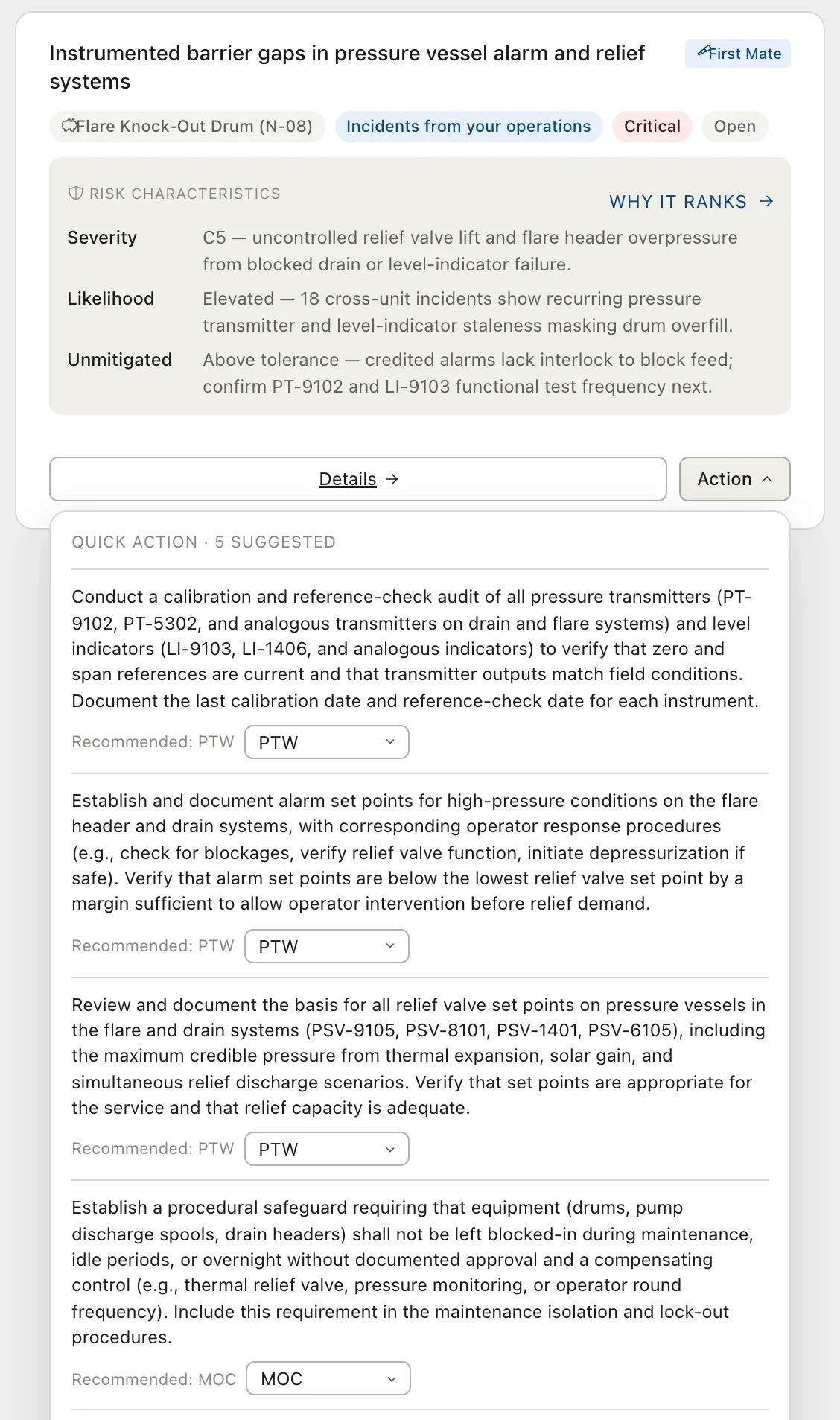
From finding to action. Each opportunity comes with suggested actions, routed to a permit to work, an MOC or a PHA review.
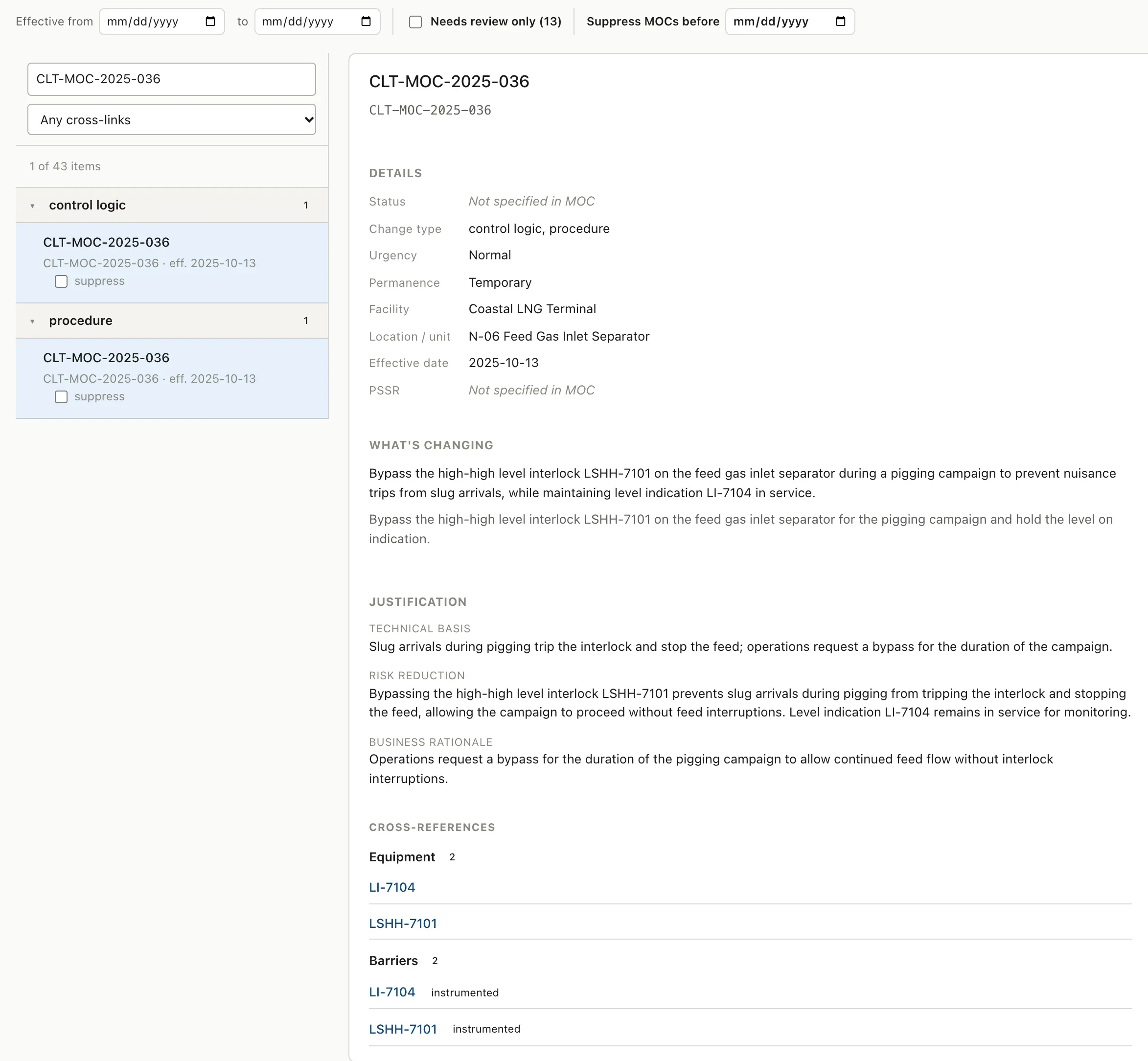
Every change, linked to the equipment and safeguards it touches. A temporary bypass of interlock LSHH-7101: what changes, why, and the two instruments and two credited barriers it affects.
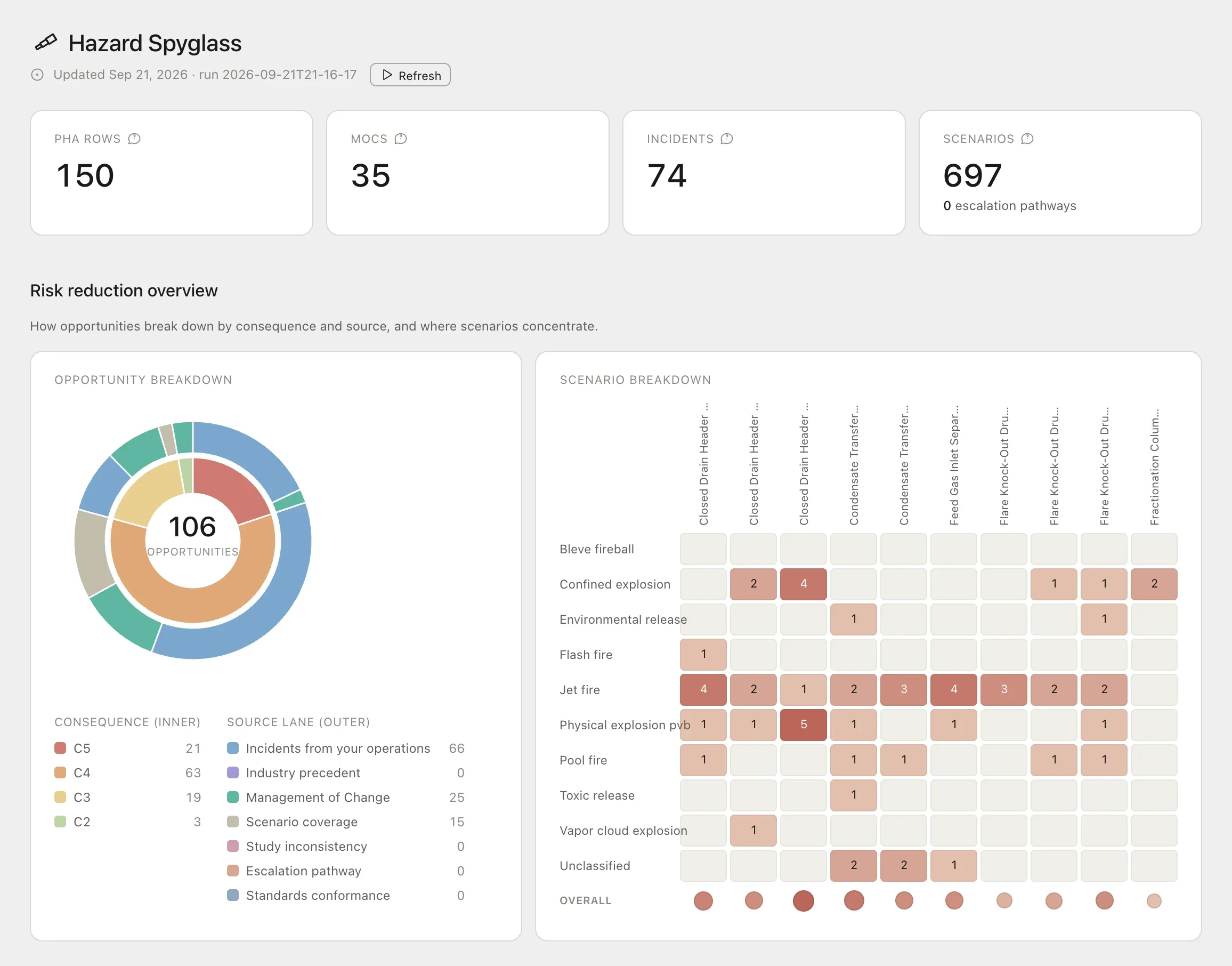
Risk tracked continuously. 106 risk-reduction opportunities by consequence and source, and where scenarios concentrate by unit.
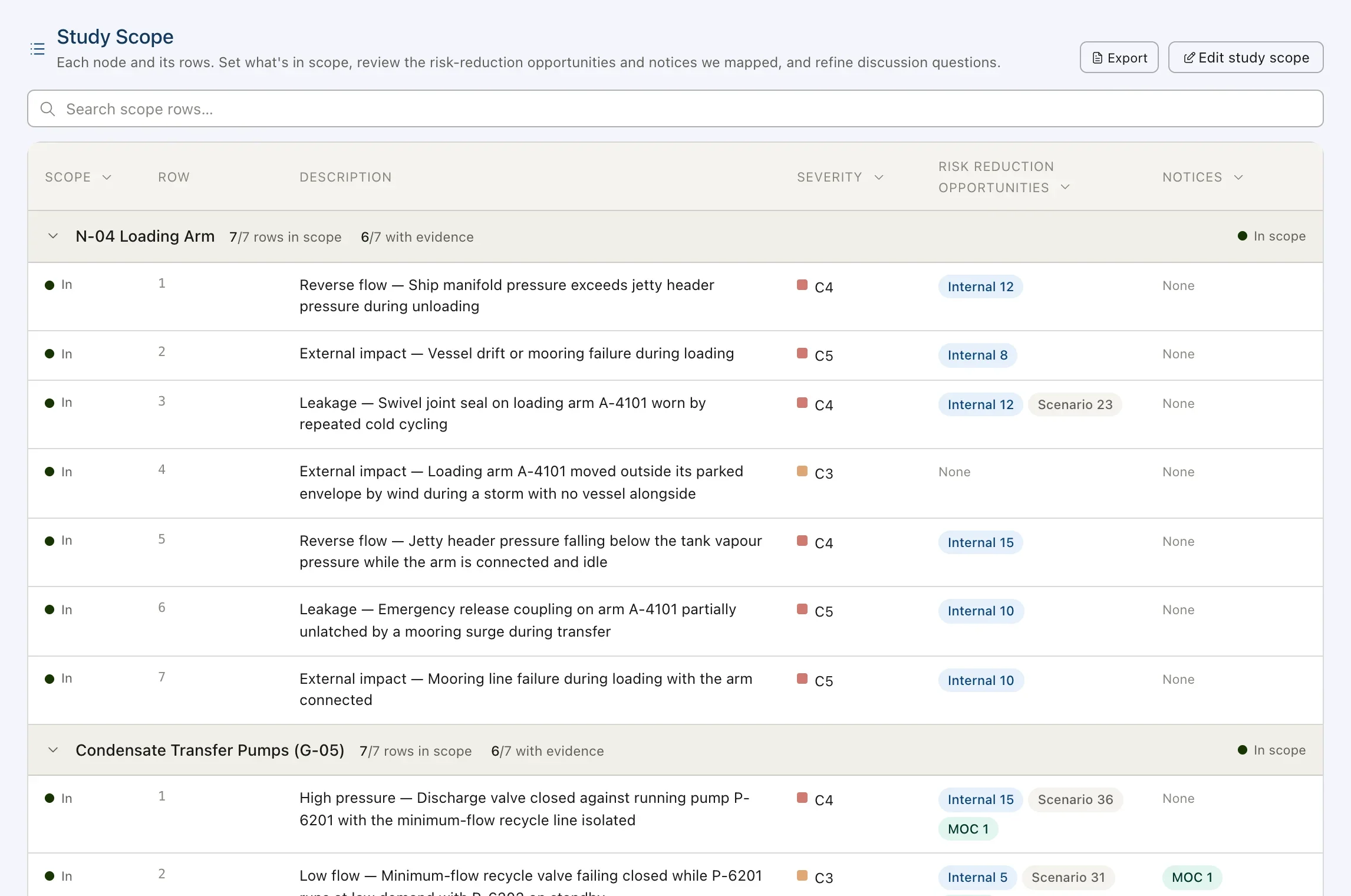
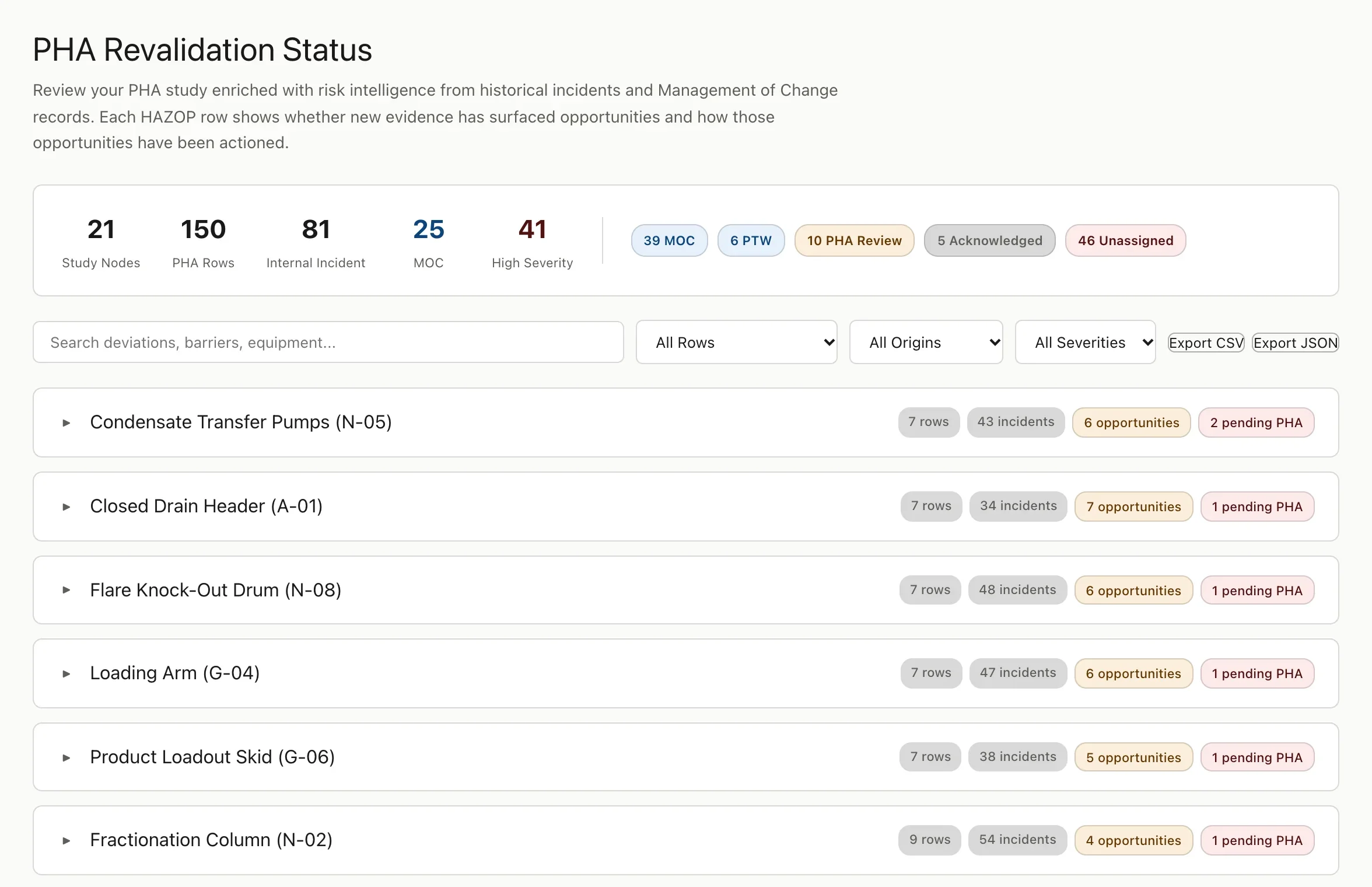
Every row, kept current. Each PHA row with the incidents, scenarios and MOCs mapped to it.
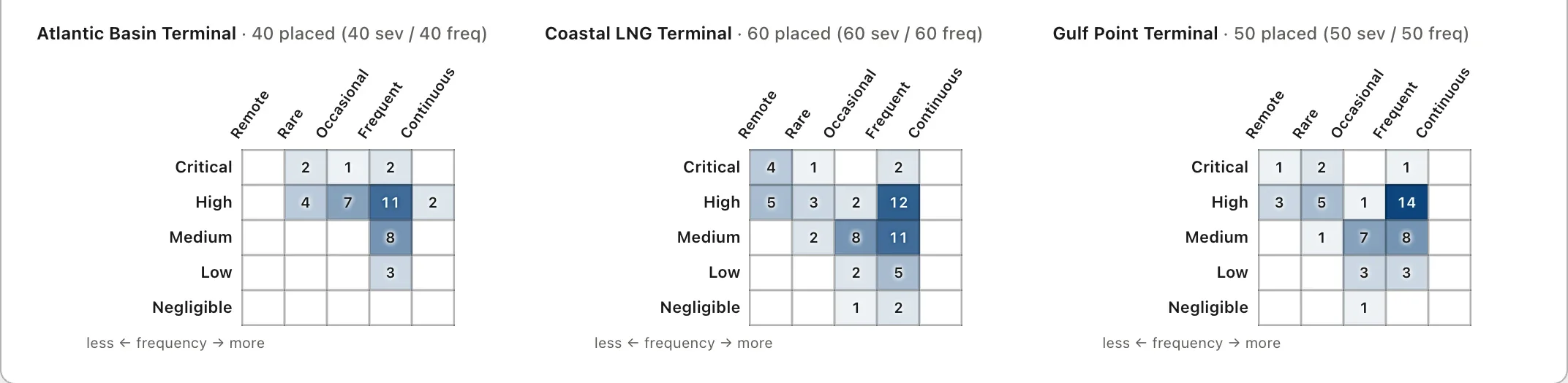
The same risk matrix, across sites. Three terminals on one normalized severity × frequency scale.
Shown on the Coastal LNG demo dataset (fictional terminals). Select any screen to open it full size.
A review layer — not an autopilot
Hazard Navigator gives your experts a governed, evidence-linked view. It does not replace their judgment, and it never touches a safety system on its own.
We work from copies of your documents — no write access to operational systems.
Your facility data stays under your control; handling is scoped to your security requirements.
Each assertion links back to its source with a content hash.
Nothing enters your hazard basis until an SME signs off.
Findings and recommendations only — the human stays in the seat.
Data handling, deployment, and security posture are agreed up front as part of pilot scoping.

See it on your own data.
A pilot runs the full analysis on one of your units and shows you what it finds.